











A cool wind wafted in from the window and outside the stars twinkled at each other, but Queen Dipika did not sleep very well that night. Some strange anxiety had started to trouble her.
Oh, why am I so worried and upset? she asked herself. She tossed and turned in her bed.
When it became dawn and King Sanjay awoke, she did not tell her husband about the troubled night she had had for fear of worrying him.
For breakfast the king and queen ate an interesting variety of small idlis, served with rasam, sambhar and an assortment of chutneys, in the dining room. There was no news of anyone coming in with a complaint and the queen began to relax.
A little after breakfast, the king and queen were enjoying some fresh coconut juice in the living room when there was a loud knock on the door.
The maid went to receive the visitor, little realising what was in store for her. The poor girl began to shake and tremble, for in front of her stood the lean but determined figure of the dreaded Churailamma. She was not at all ugly but had fine features and an aristocratic nose. Her eyes were narrowed in anger. The witch’s reputation preceded her and before she had uttered even a word, the poor maid’s teeth began to chatter.
“Ranima!” wailed the maid, which means “Queen Mother” and was how all the maids and staff addressed the queen.
“Who is it, my dear?” called the queen from the living room, wondering what on earth had happened for her maid to cry out thus.
“I will let the king and queen know about your arrival …,” stuttered the maid, recovering her composure.
“I will let them know myself,” said the witch and, pushing the maid aside, she marched inside. In her right hand she carried a polished lamp made of bronze.
She came and stood directly in front of the king and queen. The churail’s eyes breathed fire.
“Oh, my dear!” The queen understood now that the unease she had felt the previous night was a premonition of bad things to come. She clutched her husband’s arm in fear.
King Sanjay was, however, unperturbed. He was a brave man who had fought and won many battles and he was perfectly willing to confront the churail. At the same time he was also a fair-minded person, and he did consider that the witch had a legitimate grievance.
“Come, come, madame,” said the king, using all his diplomatic skills. “I’m sure we can settle this matter between us in an amicable fashion. Why don’t you take a seat and have some sherbet with us to cool you down?” He pointed to a large chair near his. “I understand that there was the small matter of a handful of leaves of a herb that our cook took from your garden …”
“I have not come here to pay a courtesy call,” said Churailamma. “And this is no – what expression did you use? – ‘small matter;. It is an extremely serious matter. Don’t you try and treat it so lightly.” She paused. “Ah, you are wondering how I can dare to threaten you. A mere woman, all by herself? But I have this magic lamp with me, you see.”
The king and queen stared at the lamp, which looked perfectly ordinary and not in any way different from thousands of other brass lamps.
The witch tapped her fingers on the lamp as if she were playing a tabla or drum, and chanted some strange sounding words at the same time. The chant went something like:
Rub-A-Dub-Dub
Dub-A-Rub-Rub
Dub-Dub-Rub-Rub
A-Dub-A-Rub-Dub-Dub
There was fire and smoke and then – whoosh! – Badlu stood in front of them. Badlu’s head nearly touched the ceiling. He bowed.
Badlu was a tall, broad-shouldered giant of a man with a huge black beard. He had thick, bushy eyebrows and a frown on his forehead that looked like it had been carved, which made him look perpetually angry. The pupils of his eyes were large and orange coloured. He was completely bald.
“At your service, madame,” he said in a loud booming voice. “Can I be of any assistance? Do you wish perhaps … for me to kill anyone?” He stared hopefully at the king and queen, and awaited instructions.
“Not for the time being,” said the witch.
One look at the fearsome, bearded giant that stood before them, and the poor queen began to perspire and tremble with fear. The king made as if to reach for his sword, but the queen tightened her grip on his arm. This was no time for bravado of any kind. The giant looked as if he could snap off any human’s neck in a matter of seconds. The king realised his wife was right in seeking to restrain him.
This was a time to exhibit the skills of diplomacy, not valour. Discretion, King Sanjay had always believed, was in any case the better part of valour. He knew now that the witch who stood before him was no ordinary person. Besides, they were here quite alone as his soldiers had not accompanied him. “What you don’t appear to understand,” said the witch, “is that my plants, flowers and herbs are like children to me. How would you feel if someone kidnapped your child?” She paused. “Ah, I see from your expression that you have no child – and so you don’t know what it would feel like. Well then, maybe you need to be taught a lesson. One that you will never ever forget.”
“We did not mean to invade your privacy or steal your plant, madame,” said the king. “Allow me to explain.”
The king tried to explain to the witch the situation regarding his wife’s possible pregnancy and how he had received medical advice to indulge her in all her cravings.
Upon hearing this explanation, the witch’s expression softened somewhat.
“All right,” she said. “I understand now why your wife ordered my precious herb to be stolen from my garden. I understand too that you wish to have a child.” She took a deep breath. “As it happens, it is in my power to grant you this, your deepest desire.”
“Really?” cried the queen. “Oh, that would be simply wonderful!”
“We would be ever so grateful!” said the king.
“But I have some conditions,” said the witch, cunningly.
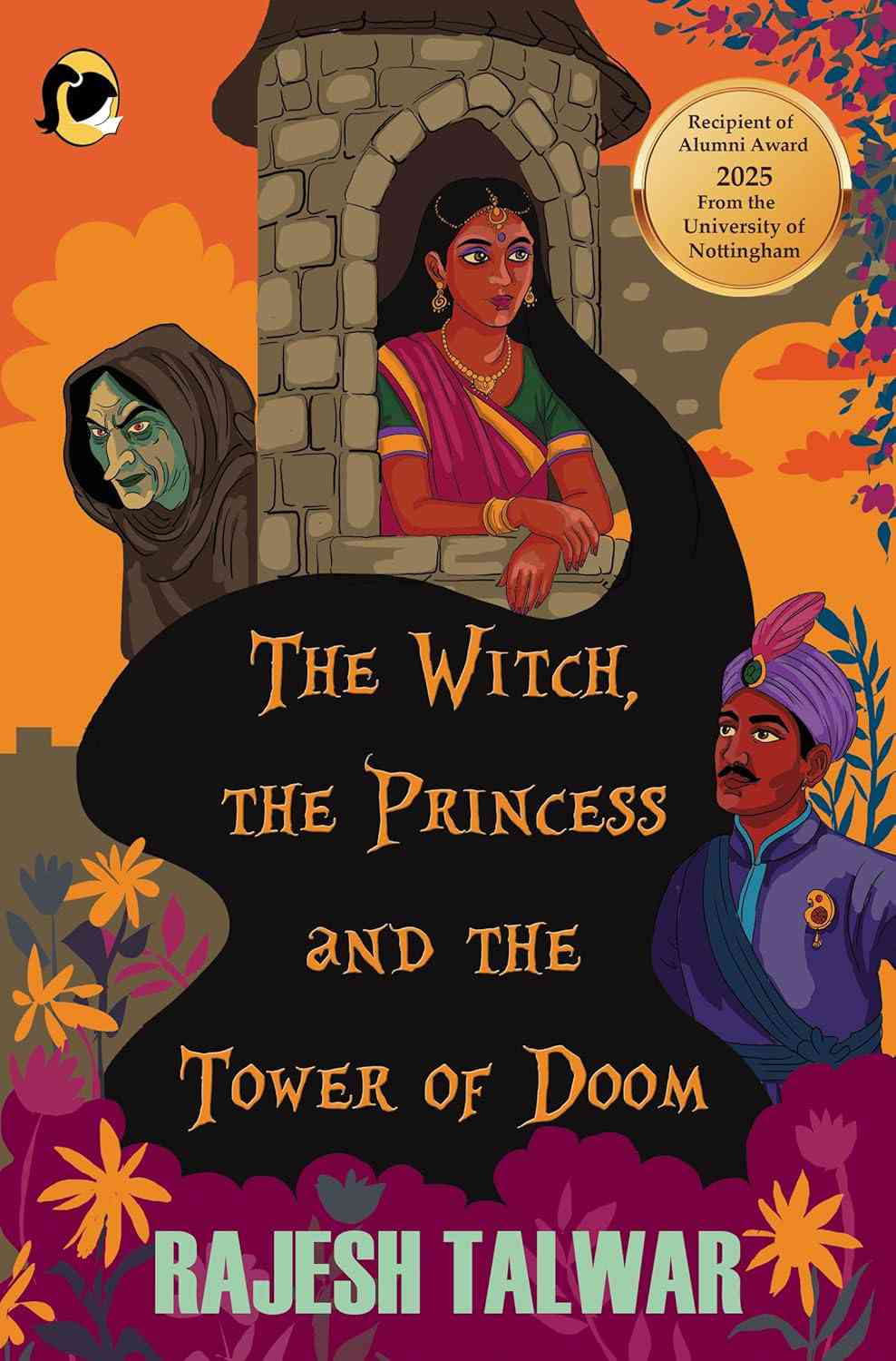
Excerpted with permission from The Witch, The Princess and the Tower of Doom, Rajesh Talwar, Ponytale Books.
